



What Is a VFD? Working, Applications, and Benefits Explained
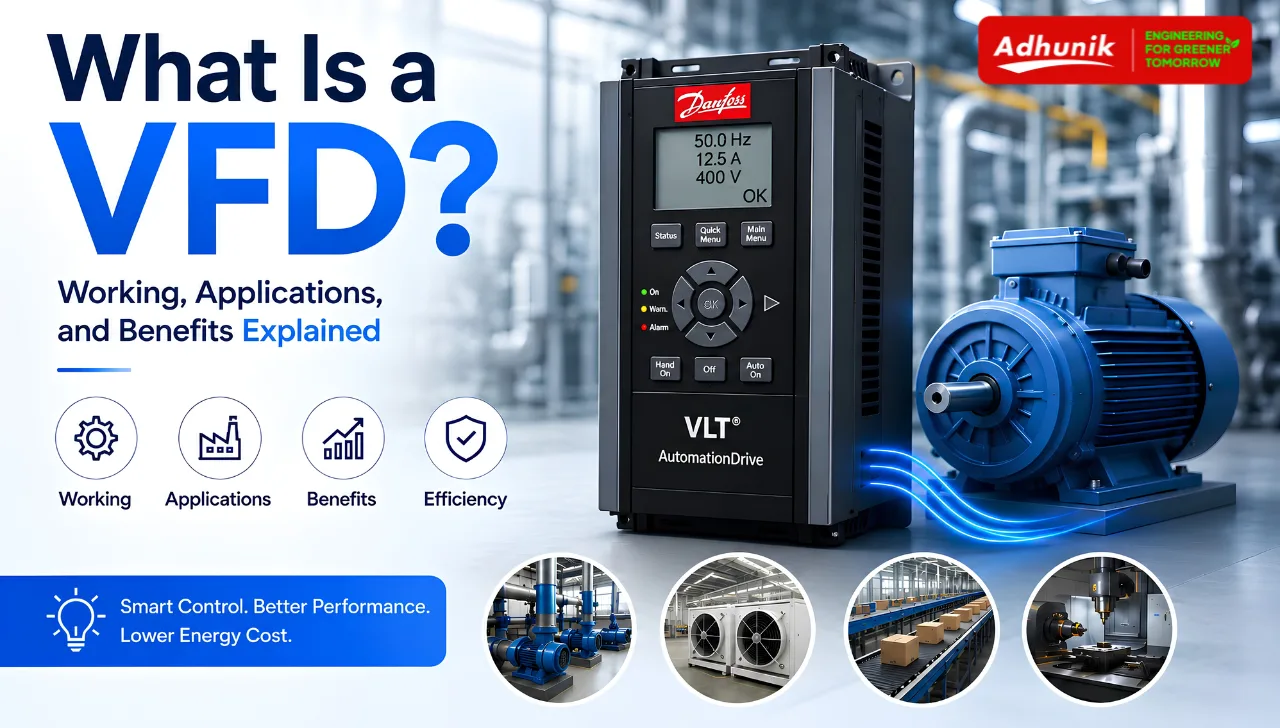
What Is a VFD? Working, Applications, and Benefits Explained is a question that comes up often when facility managers and plant engineers start looking at ways to reduce energy costs without compromising process reliability. A Variable Frequency Drive is not just another electrical component, it is a control strategy that directly impacts how motors behave under real operating conditions, especially in systems where load demand is constantly changing.
In practical terms, a VFD allows you to run motors only as fast as required instead of at full speed all the time, which is how most conventional systems operate. This shift has a direct impact on energy consumption, equipment life, and maintenance frequency. For organizations focused on operational efficiency and decarbonization, especially in HVAC systems, pumping stations, and process lines, understanding VFD fundamentals is the first step toward measurable savings.
What Is a VFD (Variable Frequency Drive)?
A Variable Frequency Drive, often referred to as VFD, is an electronic device that controls the speed and torque of an AC motor by varying the frequency and voltage supplied to it.
In a typical setup without a VFD, motors run at constant speed based on the power supply frequency. This means even when demand is low, the motor continues to operate at full capacity. A VFD eliminates this inefficiency by adjusting motor speed according to actual load requirements.
For industries such as manufacturing, healthcare facilities, hotels, and commercial buildings, this capability translates directly into lower energy consumption and improved system control. At Adhunik Automation, this is one of the most common starting points when conducting energy audits for clients across Delhi NCR.
How a VFD Works
To understand the working principle of a VFD, it helps to break it down into three core stages. These stages convert fixed electrical input into a controlled output that drives the motor efficiently.
Rectifier Stage
The incoming AC power supply is converted into DC. This is the first step and is handled by diodes or controlled rectifiers.
DC Bus Stage
The converted DC power is filtered and stored temporarily using capacitors. This ensures a stable and smooth DC supply.
Inverter Stage
The inverter converts DC back into AC, but at a variable frequency and voltage. This is done using switching devices like IGBTs controlled through pulse width modulation.
The output frequency determines the motor speed. Lower frequency results in lower speed, which reduces energy consumption significantly in variable load applications.
Why VFDs Are Used in Industry
The main reason industries adopt VFDs is to solve inefficiencies caused by fixed-speed motor operation.
In real-world operations, demand is rarely constant. Pumps, fans, and compressors often operate at partial load. Without a VFD, excess energy is wasted through mechanical control methods like throttling valves or dampers.
By using a VFD, speed control is achieved electrically rather than mechanically. This leads to better efficiency, smoother operation, and reduced stress on equipment.
Adhunik Automation frequently implements VFD retrofits in existing systems where energy losses are high due to outdated control methods.
Applications of VFD
Pumps and Water Systems
VFDs are widely used in water distribution, HVAC chilled water systems, and industrial processes.
They help regulate flow based on demand, reduce pressure fluctuations, and prevent issues like water hammer.
For a deeper understanding, you can explore how Adhunik handles water distribution optimization using VFDs.
HVAC Systems
In HVAC systems, VFDs control fans, cooling towers, and pumps.
Instead of running at full capacity, systems adjust airflow and cooling output based on occupancy and environmental conditions.
This is especially important in commercial buildings and hospitals where energy consumption is a major operational cost. Adhunik Automation has implemented multiple smart HVAC automation solutions using VFDs and control systems.
Compressors
VFDs improve compressor efficiency by matching motor speed with air demand.
This reduces load cycling, improves pressure stability, and lowers energy consumption.
Conveyors and Material Handling
In manufacturing environments, VFDs ensure smooth acceleration and deceleration.
This reduces mechanical stress, minimizes product damage, and improves overall process control.
Industrial Machinery
Machines such as mixers, crushers, and mills benefit from precise speed control, which improves output consistency and reduces wear.
Benefits of VFD
Energy Efficiency
Energy savings are the most significant benefit of using a VFD.
In variable torque applications like pumps and fans, power consumption decreases rapidly with speed reduction. Even a small drop in speed can lead to substantial energy savings.
Improved Process Control
VFDs allow precise control over motor speed, which improves process stability and product quality.
This is particularly useful in industries where consistent output is critical.
Soft Start and Reduced Electrical Stress
Traditional motor starting causes high inrush current. VFDs provide a gradual start, reducing electrical stress and preventing voltage drops.
Lower Maintenance Requirements
Because VFDs reduce mechanical stress on equipment, components such as bearings, belts, and couplings last longer.
This reduces downtime and maintenance costs over time.
Extended Equipment Life
Smooth operation and optimized speed reduce wear and tear, increasing the lifespan of motors and connected systems.
Integration with Automation Systems
Modern VFDs can integrate with PLCs, SCADA systems, and IoT platforms.
This enables real-time monitoring, predictive maintenance, and better decision-making. Adhunik Automation provides integrated solutions combining VFDs with control panels and IoT-based monitoring systems for industrial clients.
Types of VFD Control Methods
V/Hz Control
This is the most basic and cost-effective method, suitable for general applications like pumps and fans.
Vector Control
Provides higher accuracy and better torque control, used in applications requiring precision.
Closed Loop Control
Uses feedback devices for highly accurate speed and torque control in critical processes.
Key Considerations Before Installing a VFD
Before selecting or installing a VFD, it is important to evaluate:
- Motor specifications and compatibility
- Load characteristics, whether variable or constant
- Environmental conditions such as temperature and dust
- Cooling and ventilation requirements
- Harmonics and power quality
Improper selection or installation can lead to inefficiencies and equipment failure.
Maintenance and Reliability Tips
To ensure long-term performance of a VFD system:
- Keep panels clean and well-ventilated
- Check electrical connections regularly
- Monitor temperature and load conditions
- Inspect cooling fans and heat sinks
For facilities that do not have in-house expertise, opting for professional AMC services helps maintain system reliability. Adhunik Automation offers VFD repair and maintenance services in Delhi NCR to support uninterrupted operations.
FAQ
How does a VFD work in simple terms?
A VFD controls motor speed by converting fixed AC power into DC and then back into AC with a variable frequency. This change in frequency directly controls how fast the motor runs. Instead of running at full speed all the time, the motor adjusts based on actual demand, which improves efficiency and reduces energy consumption.
Why is a VFD used in industrial applications?
VFDs are used to improve operational efficiency and reduce energy costs. In industries, loads are rarely constant, so running motors at full speed leads to unnecessary energy usage. A VFD allows motors to match real-time demand, improves process control, and reduces mechanical stress on equipment.
What are the main benefits of using a VFD?
The key benefits include:
- Significant energy savings, especially in pumps and fans
- Smooth motor starting, which reduces electrical and mechanical stress
- Better process control and consistent output
- Lower maintenance costs due to reduced wear and tear
- Longer lifespan of motors and connected equipment
These benefits are why many facilities work with experts like Adhunik Automation to implement VFD-based optimization.
Where are VFDs commonly used?
VFDs are widely used across multiple industries and systems, including:
- HVAC systems in commercial buildings and hospitals
- Water pumps and distribution systems
- Air compressors
- Conveyors and material handling systems
- Industrial machines like mixers and crushers
Any application where motor speed needs to vary based on demand is a good candidate for a VFD.
Does installing a VFD always guarantee energy savings?
Not always. Energy savings depend on the type of load and application. VFDs provide the highest savings in variable torque applications such as pumps and fans. In constant torque applications, the benefit is more about control and reduced mechanical stress rather than large energy savings.
A proper system assessment or energy audit, like those conducted by Adhunik Automation, helps identify where VFD implementation will deliver the best ROI.
What is the difference between a VFD and a soft starter?
A soft starter only controls the starting and stopping of a motor to reduce inrush current. Once the motor reaches full speed, it operates normally.
A VFD, on the other hand, continuously controls motor speed during operation. This makes it more suitable for applications where speed needs to change based on demand.
Can a VFD damage a motor if not selected properly?
Yes, incorrect selection or poor installation can cause issues such as overheating, insulation stress, or harmonic distortion. It is important to consider motor compatibility, load type, cooling requirements, and power quality before installation.
Working with experienced providers like Adhunik Automation helps avoid these issues through proper sizing and system integration.
What maintenance does a VFD require?
VFDs require basic but regular maintenance to ensure reliability:
- Cleaning dust from panels and cooling fans
- Checking electrical connections
- Monitoring temperature and load conditions
- Inspecting capacitors and cooling systems
Facilities that do not have dedicated maintenance teams often opt for AMC services to ensure long-term performance.
How do VFDs support energy efficiency and decarbonization goals?
By reducing unnecessary energy consumption, VFDs directly lower electricity usage, which reduces carbon emissions. For industries aiming to meet sustainability targets, VFDs are one of the most practical and cost-effective upgrades.
They also integrate with modern automation and monitoring systems, enabling better energy tracking and optimization strategies.
Final Thoughts
A Variable Frequency Drive is one of the most practical upgrades for any facility looking to reduce energy consumption and improve operational control. Its impact is most visible in systems that operate under variable load conditions, which covers a large portion of industrial and commercial applications.
Adhunik Automation, as a Danfoss authorized VFD dealer, works closely with facility teams to identify where VFD implementation or optimization can deliver measurable results. From supply and installation to retrofit projects, energy audits, and AMC support, their approach is focused on real performance improvements rather than theoretical benefits.
If you are evaluating opportunities to reduce energy costs or improve system efficiency, a detailed assessment is the right starting point. You can explore solutions like Danfoss VFD systems or consult with the Adhunik Automation team for a practical evaluation of your current setup.