



Soft Starter vs VFD: Which One is Right for Your Motor Application?
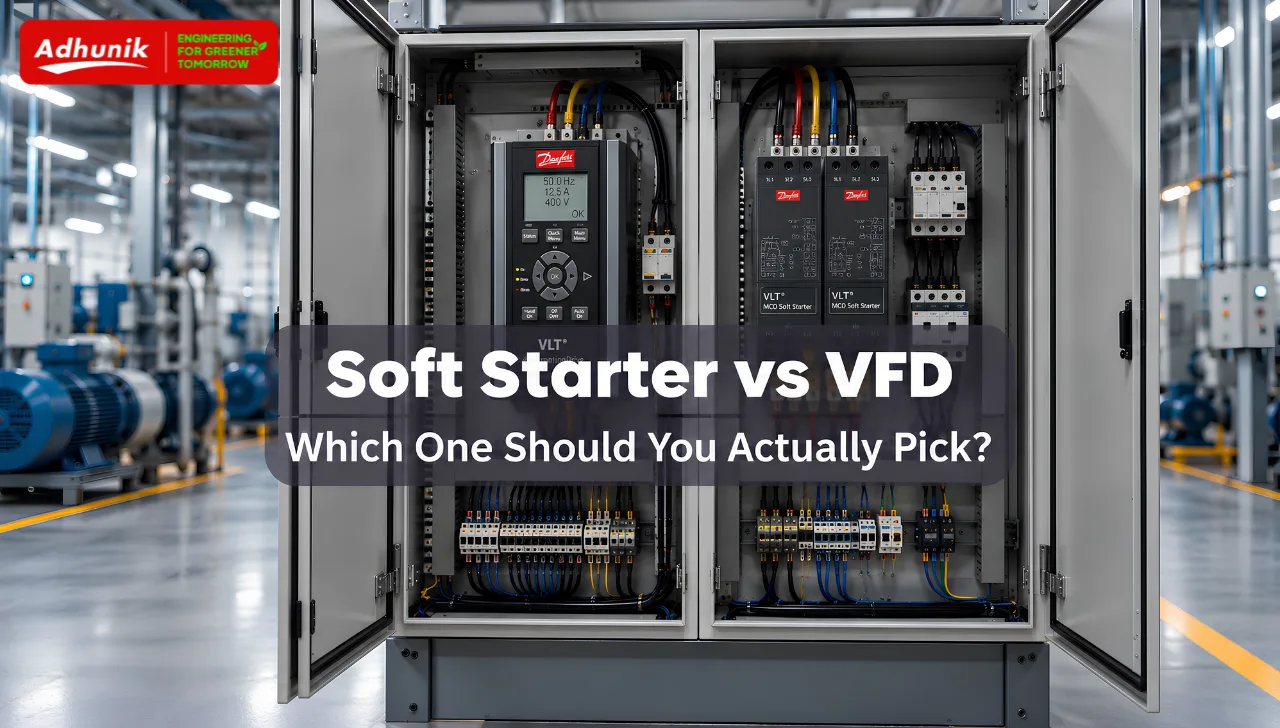
When you are setting up motor control for a pump, fan, compressor, or conveyor, one of the first decisions you face is whether to go with a soft starter or a Variable Frequency Drive. Both control how a motor starts, but they work very differently and suit different applications.
This article breaks down the soft starter vs VFD comparison in plain terms, what each one does, where each one works best, and how to decide which is the right choice for your specific situation.
What is a Soft Starter?
A soft starter is an electronic device that controls the voltage supplied to a motor during startup. Instead of applying full voltage all at once, which causes a high inrush current and mechanical jerk, the soft starter gradually ramps up the voltage until the motor reaches full speed.
Once the motor is running at full speed, the soft starter is bypassed and the motor runs directly on the mains supply. The soft starter is only active during the start and stop phases.
What a soft starter does:
- Reduces starting current, typically from 6 to 8 times full load current down to 2 to 4 times
- Reduces mechanical stress on the motor, shaft, and connected equipment during startup
- Allows a controlled ramp-down stop, useful for pumps to prevent water hammer
- Protects the motor from voltage fluctuations during starting
What a soft starter does not do:
- It does not control motor speed during normal operation
- It does not save energy during running: once bypassed, the motor runs at full speed
- It cannot adjust speed based on load demand
What is a VFD?
A Variable Frequency Drive controls both the voltage and frequency supplied to the motor, which directly controls motor speed throughout its entire operation, not just at startup.
A VFD converts incoming AC power to DC and then back to AC at a controlled frequency. By adjusting the output frequency, it adjusts motor speed precisely, from near zero to full speed and anywhere in between.
What a VFD does:
- Controls motor speed continuously, not just at start and stop
- Reduces energy consumption significantly when running at partial speed, a motor at 80 percent speed uses roughly 50 percent less energy
- Provides soft starting as a built-in function, no separate soft starter needed
- Enables precise process control, constant pressure, constant flow, constant temperature
- Reduces motor and mechanical wear by eliminating full voltage starting
- Supports communication with BMS, SCADA, and PLC systems via Modbus, BACnet, and other protocols
Soft Starter vs VFD : Key Differences
| Parameter | Soft Starter | VFD |
|---|---|---|
| Speed control | No, only at start and stop | Yes; full range, continuous |
| Energy saving | Minimal, only at startup | Significant, throughout operation |
| Starting current reduction | Yes | Yes, built in |
| Process control | No | Yes |
| BMS and PLC integration | Limited | Full, Modbus, BACnet, Profibus |
| Cost | Lower upfront cost | Higher upfront cost |
| Best application | Fixed speed loads | Variable speed loads |
| Maintenance | Simpler | Slightly more complex |
| Motor protection | Basic | Advanced: overload, phase loss, overvoltage, harmonics |

When to Use a Soft Starter
A soft starter makes sense when:
The load runs at fixed speed
If your application does not need speed variation, a conveyor running at one constant speed, a compressor that is either on or off, or a pump that operates at a fixed duty point, a soft starter handles the starting requirements at a lower cost.
Starting current is the main concern
If your facility has a limited power supply or a generator that struggles with high inrush current during motor starting, a soft starter limits that inrush without the added complexity of a full drive.
Budget is a primary constraint
A soft starter costs significantly less than a VFD of the same rating. If the application genuinely does not require speed control or energy savings during running, a soft starter is a practical and economical choice.
Typical applications:
- Conveyor belts running at constant speed
- Air compressors; fixed speed scroll or reciprocating types
- Large pumps where starting current needs to be limited but speed does not vary
- Fans with fixed airflow requirements
When to Use a VFD
A VFD vs soft starter comparison almost always favours the VFD when:
The load has variable demand
Pumps, fans, and compressors in HVAC systems rarely run at full load all the time. A chilled water pump serving a building runs at 60 to 70 percent of full load for most of the year. A VFD adjusts pump speed to match actual demand, saving 40 to 50 percent on electricity costs over a fixed speed pump with a soft starter.
Energy saving is a priority
The cubic law of fan and pump affinity laws means that reducing speed by even 20 percent cuts power consumption by nearly 50 percent. A soft starter cannot achieve this because once the motor is running, it has no control over speed. A VFD does, and this is why energy audits almost always recommend VFD installation as the highest-priority energy saving measure.
Process control is needed
If you need constant pressure in a water system, constant airflow in a ventilation system, or constant temperature in a process, a VFD with a PID controller achieves this automatically. A soft starter cannot.
BMS or automation integration is required
Modern building management systems and industrial automation platforms communicate with drives over Modbus, BACnet, or Profibus. VFDs support this natively. Soft starters have very limited communication capability.
Typical applications:
- HVAC chilled water pumps and condenser water pumps
- Air handling unit fans and cooling tower fans
- Water treatment plant pumps
- Compressors with variable load profiles
- Any application where an energy audit has identified speed control as a saving opportunity
VFD vs Soft Starter — Energy Savings Comparison
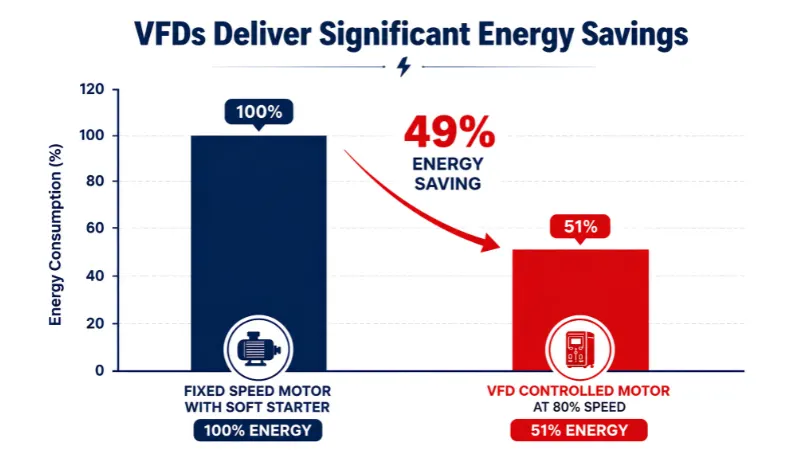
This is the most important factor for most industrial facilities in India.
A soft starter saves energy only during the brief starting period, typically 5 to 30 seconds. After that, the motor runs at full speed regardless of the actual load on the system.
A VFD vs soft starter energy comparison over a full year looks like this for a typical 22 kW pump running 16 hours a day:
| Soft Starter | VFD | |
|---|---|---|
| Average motor speed | 100% | 75% |
| Power consumption | 22 kW | ~9.3 kW (cube law) |
| Annual energy (16 hrs, 300 days) | 1,05,600 kWh | 44,640 kWh |
| Annual saving at Rs. 8/unit | — | Rs. 4,87,680 |
The VFD pays for itself in 12 to 18 months in most applications. A soft starter would not produce anywhere near this saving.
This is why Adhunik Automation recommends a proper energy audit before specifying any motor control solution, the audit data tells you exactly which motors are running at partial load and what the payback period on a VFD installation will be.
Can a VFD Replace a Soft Starter Completely?
Yes, in almost every application. A VFD includes soft starting as a built-in function. You can set the ramp-up time, current limit, and starting torque directly in the drive parameters. There is no scenario where a soft starter can do something a VFD cannot.
The only reason to choose a soft starter over a VFD is cost. If speed control and energy saving during running are not needed and the budget is tight, a soft starter is a practical choice. But if there is any possibility of variable load or future energy saving requirements, a VFD is the better long-term investment.
VSD vs VFD — Are They the Same Thing?
A common point of confusion. VSD stands for Variable Speed Drive. VFD stands for Variable Frequency Drive. In most industrial applications in India, these terms refer to the same device, an electronic drive that controls motor speed by varying frequency and voltage.
The VFD and VSD difference is mainly terminology. Some manufacturers use VSD as a broader term that includes hydraulic and mechanical variable speed systems, but in the context of modern industrial motor control, VSD and VFD mean the same thing.
Soft Starter vs VFD — Which One Does Adhunik Recommend?
For most HVAC, water treatment, and industrial applications, VFD is the right choice. The energy savings alone justify the higher upfront cost in most cases, and the additional process control capability makes the installation more flexible and future-proof.
Adhunik Automation is an authorized Danfoss dealer supplying the complete range of Danfoss VLT and VACON drives across Delhi NCR, Ghaziabad, Noida, Faridabad, and Gurugram. We also supply Danfoss MCD soft starters for applications where a soft starter is genuinely the right fit.
If you are not sure which is right for your application, our team can review your motor specifications, duty cycle, and load profile, and give you a clear recommendation with estimated payback period before you make a decision.
Call: +91 93100 85027
Email: kaushik@adhunikautomation.com
Frequently Asked Questions
A soft starter controls motor voltage only during starting and stopping. A VFD controls motor speed throughout the entire operation by varying both voltage and frequency. A VFD can do everything a soft starter does, plus continuous speed control and energy saving during running.
Yes, significantly. A soft starter saves energy only during the brief starting period. A VFD saves energy continuously by matching motor speed to actual load demand. For pumps and fans running at partial load, VFD energy savings of 30 to 50 percent are common.
Yes. A VFD includes soft start functionality as a standard feature. You can set ramp-up time and current limit in the drive parameters. Replacing a soft starter with a VFD adds speed control and energy saving capability at a higher upfront cost.
Use a soft starter for fixed-speed loads where speed control isn’t needed and reducing starting current is the main priority.