



VFD Applications: Where and How Variable Frequency Drives Are Used
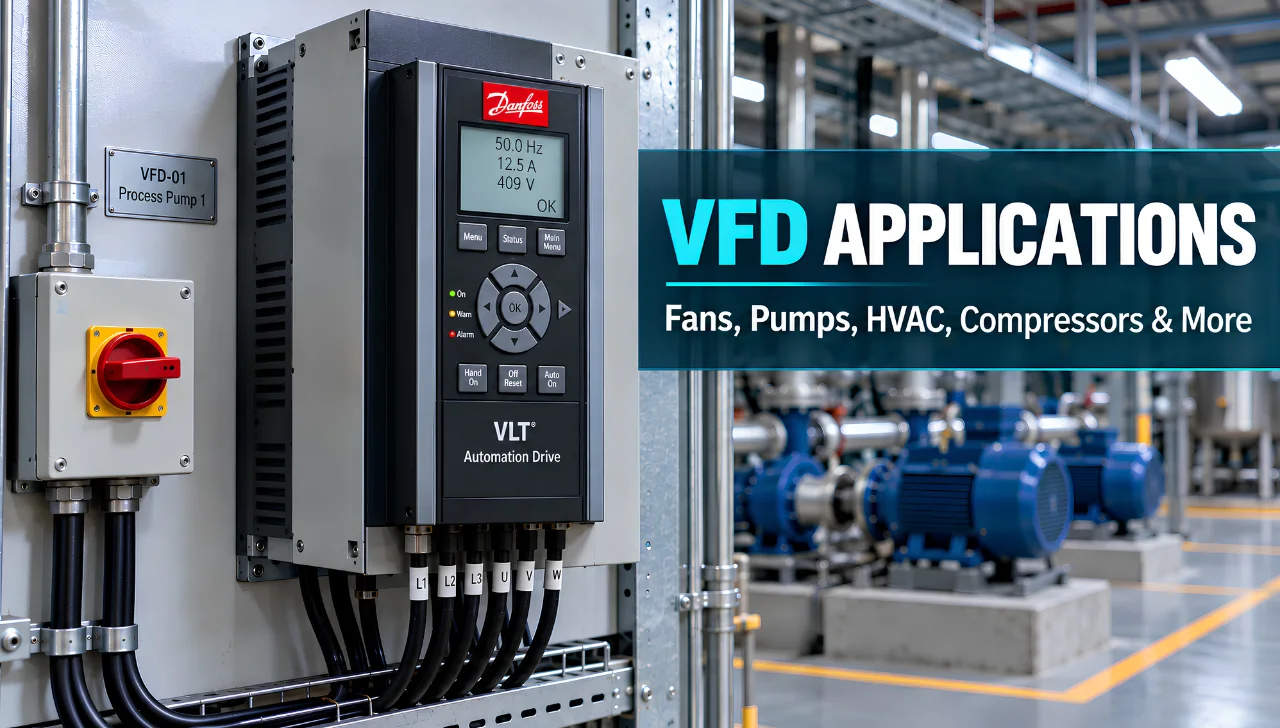
If you’ve spent any time around industrial motors, you’ve probably heard someone mention a VFD without much explanation of where it actually gets used. Variable frequency drives show up in more places than most people expect, not just big factory floors, but office building fans, hospital pumps, farm irrigation, and machine shops running a single lathe. The reason is simple: almost any motor that doesn’t need to run at one fixed speed all the time can benefit from one.
This piece walks through the main areas where VFDs get put to work, what they actually change about how a motor runs, and which motor types they pair with.
Why Motors Need Speed Control in the First Place
A standard motor connected directly to mains power runs at close to its rated speed the moment it’s switched on, full speed, full draw, no in-between. That’s fine for equipment that genuinely needs to run flat out. But a lot of industrial and commercial equipment doesn’t. A fan cooling an empty office at 2 AM doesn’t need the same airflow as at 2 PM on a hot afternoon. A pump feeding a tank that’s nearly full doesn’t need to push at the same rate as one filling from empty.
A VFD sits between the power supply and the motor and adjusts the frequency of the electricity going to it, which in turn changes how fast the motor spins. Slow the motor down when demand drops, and you cut electricity use roughly in proportion, sometimes more, since pump and fan loads follow what’s called an affinity law where power draw falls off faster than speed does. That’s the main draw for most buyers, but it’s not the only one. Soft starts reduce mechanical stress on belts, couplings, and bearings. Precise speed matching reduces wear on components that would otherwise take repeated jolts from full-speed starts. Over time, that adds up to fewer breakdowns and longer equipment life.
Fans and Air Handling
Exhaust fans and supply fans are one of the most common places you’ll find a VFD, and for good reason, fan loads are exactly the kind that benefit most from the affinity law relationship between speed and power. A fan running at 80% speed uses roughly half the power of one running flat out, even though it’s only moving 20% less air.
In commercial and industrial settings, this shows up in kitchen exhaust systems, basement ventilation, and process cooling fans that need to track demand rather than run at one fixed output all day. Pairing a fan motor with a VFD also means it starts and stops gently, which matters for belt-driven fans where a hard start can snap a belt or stress the pulley over time.
Pumps and Water Treatment

Pumping is arguably where VFDs deliver the clearest payback. Water and wastewater treatment plants run pumps almost continuously, and flow demand shifts through the day, intake volumes change, treated water demand rises and falls, and transfer pumps don’t always need to move water at the same rate. Running these pumps at fixed speed and throttling output with a valve wastes energy that a VFD would simply not draw in the first place.
Beyond treatment plants, this extends to building water supply systems, irrigation, and cooling tower circuits. Many of these applications now pair a VFD with a PLC based pump controller, which automates the speed adjustment based on pressure or flow sensor feedback rather than requiring manual tuning.
HVAC Systems
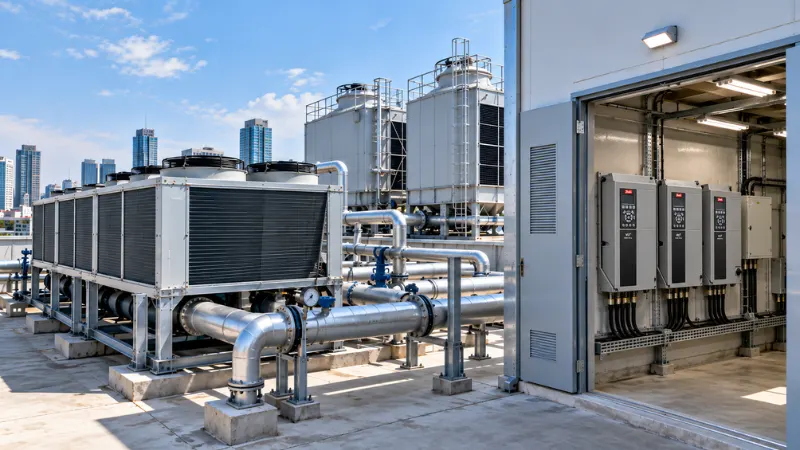
Heating and cooling systems are a category of their own because they combine several motor types, chilled water pumps, condenser pumps, cooling tower fans, and air handling unit fans, all of which see genuinely variable demand depending on occupancy, outside temperature, and time of day.
A VFD-equipped HVAC system adjusts each of these independently rather than running everything at full output and controlling temperature with dampers or bypass valves. That’s a meaningful difference in a commercial building’s electricity bill, and it’s typically one of the largest line items an energy audit turns up when a facility hasn’t already made the switch. Fan-side control specifically often runs through a PLC based ventilation fan setup, which ties fan speed to air quality or occupancy sensors instead of a fixed schedule.
Compressors and Conveyors
Air compressors historically ran as simple on-off systems, cycling between full output and idle. A VFD-driven compressor instead ramps its motor speed to match actual air demand, avoiding the energy waste of running a compressor at full load when only a fraction of that output is needed. This matters more in facilities where compressed air demand swings, packaging lines, pneumatic tooling, and intermittent process equipment all fit this pattern.
Conveyors present a different case. Speed control here isn’t just about energy, it’s about matching line speed to upstream and downstream processes without jarring starts that could damage product or spill loose material. A VFD lets a conveyor ramp up and down smoothly, which protects both the mechanical drivetrain and whatever’s riding on the belt.
Machine Tools — Lathes and Drill Presses
On the machine shop floor, VFDs solve a different problem: matching spindle speed to the material and tool being used. A lathe cutting soft aluminum needs a different spindle speed than one working hardened steel, and older machines often achieved this with mechanical gearboxes or belt-and-pulley arrangements that limited you to a handful of fixed speeds.
A VFD on a lathe or drill press replaces that with continuously adjustable speed, letting an operator dial in exactly what a given job calls for rather than picking the closest available gear ratio. It also protects the motor during start-up, which matters on older machines where a sudden full-speed start puts real stress on aging bearings and drivetrain components.
Textile, Food & Beverage, and Mining
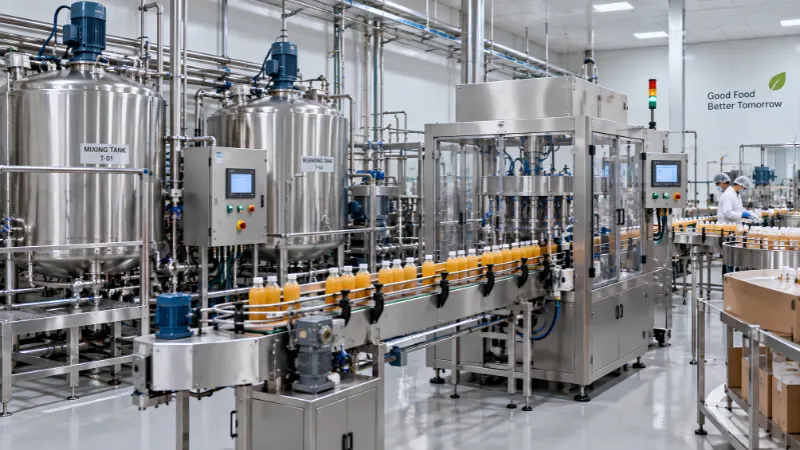
A few industries deserve a specific mention because of how central VFDs have become to their operations. Textile plants use them across spinning, weaving, and dyeing lines, where consistent speed directly affects fabric quality, uneven speed shows up as uneven yarn tension or fabric weight. Food and beverage plants use VFDs on mixers, fillers, and packaging conveyors, where gentle starts and precise speed matching protect both the product and hygiene standards, since many of these drives now come in washdown-rated enclosures built for wet processing environments.
Mining and quarrying operations use VFDs on crushers and material-handling conveyors, where they adjust torque to match the hardness of the material being processed rather than applying constant force regardless of load. This reduces strain on drivetrains that would otherwise take a beating from handling inconsistent rock sizes at a fixed speed.
Which Motors Work With a VFD
Most VFD applications use three-phase induction motors, which is what the majority of industrial and commercial equipment runs on. Three-phase motors pair naturally with VFDs because the drive can generate a clean, balanced three-phase output regardless of what it’s fed on the input side.
This raises a common question: can you run a three-phase VFD on single-phase input power? Smaller VFDs, generally up to a few horsepower, are often built to accept single-phase input and still output three-phase power to the motor, this is common in smaller pump and fan installations where only single-phase supply is available. Larger drives typically need three-phase input to deliver their full rated output. Single-phase motors themselves are a separate case; they can be run through certain VFDs designed for that purpose, but the control strategy differs from three-phase motor control, so it’s worth checking a drive’s specification sheet rather than assuming compatibility.
Frequently Asked Questions
VFDs are used anywhere a motor needs variable speed instead of fixed speed, fans, pumps, compressors, conveyors, HVAC systems, machine tools, and process equipment in industries like textiles, food and beverage, and mining. The common thread is a load that doesn’t need to run flat out all the time.
The biggest one is energy savings, since slowing a fan or pump down cuts power draw more than proportionally. Beyond that, VFDs reduce mechanical wear through soft starts and stops, give finer process control, and generally extend the working life of the motor and connected equipment.
Yes. A VFD lets an operator set spindle speed to match the material and cutting tool instead of relying on a fixed gear ratio, and it also protects the motor from the stress of a sudden full-speed start.
Yes, induction motors are the most common motor type paired with VFDs. Most industrial and commercial equipment already runs on three-phase induction motors, and VFDs are built to control them efficiently across a wide speed range.
Getting the Right Fit
The application determines the drive, not the other way around. A fan or pump application generally needs less sophisticated control than a crane, elevator, or precision machine tool, where torque control and positioning accuracy matter more. Getting this match wrong, under sizing a drive for a hard-starting load, or overspending on features a simple fan doesn’t need is one of the more common mistakes in VFD selection.
If you’re evaluating where a VFD would make sense in your own facility, our team looks at the actual load profile and duty cycle before recommending a drive size or type, and we support installations across the industries we serve with sizing, commissioning, and ongoing AMC support once the drive is running.
Get in touch if you’d like a site assessment.