



Common VFD Fault Codes and How to Troubleshoot Them
If you’ve ever walked up to a VFD panel and found it flashing a fault code instead of running your motor, you know the sinking feeling. Production stops, someone’s calling you asking why the pump isn’t running, and you’re staring at a two or three letter code with no idea what it means. The good news is that most VFD faults fall into a handful of common categories, and once you know what to look for, troubleshooting gets a lot less stressful.
This article walks through the fault codes you’ll run into most often, what usually causes them, and where to start looking before you call for a repair.
Why VFDs Trip on Faults in the First Place
A VFD constantly watches current, voltage, temperature, and a handful of other parameters in real time to keep how a VFD works safe and efficient. The moment something crosses a threshold it’s programmed to shut down rather than risk damage to itself, the motor, or the connected equipment. That’s actually a good thing. A vfd fault trip is the drive doing its job, not failing at it. The trouble is figuring out which threshold got crossed and why.
Most manufacturers use their own naming conventions for fault codes, so a Danfoss drive and a different brand won’t show identical codes on the display. But the underlying causes repeat across brands, which means once you understand the categories, you can handle vfd drive troubleshooting on almost any drive even without the manual in front of you.
VFD Overcurrent Trip
What it means: The drive detected current higher than the motor is rated for.
Common causes:
- Motor starting against too much load
- Mechanical jam in the pump, fan, or conveyor
- Acceleration ramp set too fast
What to check: Inspect the driven equipment for anything physically stuck, and slow down the acceleration time setting if the mechanical side looks fine.
Overload Fault
What it means: The motor has drawn high current for longer than the drive allows, sustained overwork rather than a sudden spike.
Common causes:
- A vfd motor overload fault often traces back to a motor undersized for the load, a mismatch that shows up differently depending on how VFDs are used across industries, pumps and fans behave differently under load than compressors or conveyors.
- Excess friction somewhere in the system.
- Motor parameters in the drive not matching the actual nameplate.
What to check: Compare the motor nameplate current with what’s programmed in the drive, then check for mechanical resistance in bearings, belts, or couplings.
Ground Fault
What it means: Current is leaking to earth instead of staying inside the motor circuit.
Common causes: A ground fault vfd trip usually points to insulation breakdown in the motor windings, or a damaged, moisture-affected cable.
What to check: Megger test the motor and cable separately from the drive. Moisture inside junction boxes or cable glands is a common culprit outdoors. A low insulation reading on a vfd ground fault test usually means rewinding or cable replacement.
Short Circuit Fault

What it means: A direct short between phases or to ground, the drive shuts down almost instantly to protect itself.
Common causes: A short circuit fault for vfd can come from a short between motor phases, a short to ground, or a fault inside the drive’s own output components on older units.
What to check: Disconnect the motor cable and test the drive alone. If it still trips with nothing connected, the fault is inside the drive, and this one is safer left to a qualified technician.
Phase Loss / Phase Imbalance Fault
What it means: One of the three incoming power phases is missing or unbalanced.
Common causes:
- Loose terminal connection
- Blown fuse on one phase
- Problem with the incoming power supply
What to check: Measure voltage across all three phases at the drive’s input, then trace back toward the panel until you find the loose connection or blown fuse.
Communication Fault
What it means: The drive has lost its connection to a PLC, HMI, or SCADA system.
Common causes: Loose or damaged communication cable, a protocol or baud rate mismatch, or a network drop.
What to check: Inspect the physical cable and connectors first, then confirm protocol settings and drive address match the controlling system.
Safe Torque Off (STO) Fault
What it means: This isn’t a typical fault, it’s a safety function working as intended. A safety circuit has opened and removed torque from the motor.
Common causes: An emergency stop pressed, a safety door or guard open, or a tripped safety relay.
What to check: Look for a pressed E-stop or open safety door first, this usually just needs the safety device reset, not a repair.
Other Faults to Know
Overvoltage: Happens during deceleration when a heavy load, like a large fan, keeps spinning and feeds voltage back into the drive. Extending the deceleration time or adding a braking resistor usually fixes it.
Undervoltage: Points to a weak incoming supply, loose connections, or voltage drops on the line.
Overtemperature: Almost always a cooling issue, check the heatsink fan, airflow around the panel, and ambient temperature.
A Simple Troubleshooting Approach
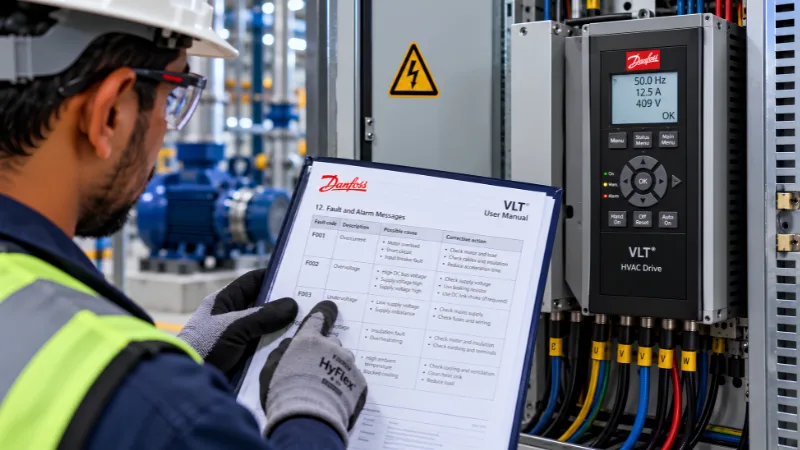
- Note the exact fault code and check it against the drive manual
- Look for anything physical first, loose wires, damage, blockages
- Compare motor parameters in the drive against the actual nameplate
- Don’t keep resetting a fault that keeps returning, call for help instead
Repeatedly resetting a fault without fixing the cause, especially for a VFD overcurrent trip, ground fault, or short circuit, can end up damaging the drive or motor further.
When to Call for Professional Support
Some faults, like a bad ramp setting or a mismatched parameter, take minutes to fix on your own. Others, especially ground faults, short circuits, and anything involving the drive’s internal components, are worth having a trained technician look at.
If you’re dealing with recurring faults on a Danfoss drive or any other VFD installation, our team handles VFD repair across Delhi NCR, along with ongoing AMC support to catch these issues early. Get in touch if you’re dealing with a fault that won’t clear.
Frequently Asked Questions
The ones you’ll see most often are overcurrent, overload, overvoltage, undervoltage, ground fault, phase loss, communication fault, and overtemperature. Most VFD troubleshooting starts by identifying which of these categories a fault code falls into before digging deeper
It’s usually a mechanical jam in the driven equipment, an acceleration ramp set too fast for the load, or the motor trying to start against more resistance than expected.
It means the drive has detected current leaking to earth instead of staying within the motor circuit. This often points to insulation breakdown in the motor windings or cable, and is usually confirmed with a megger test.
It’s a safety function, not a typical electrical fault. It triggers when an emergency stop, safety door, or safety relay opens, and it removes torque from the motor as a protective measure until the safety circuit is reset.
A fault that keeps returning after a reset means the underlying cause hasn’t actually been fixed. Repeatedly resetting without addressing it risks damaging the drive or motor further.
A missing or unbalanced input phase, usually from a loose terminal connection, a blown fuse, or a problem with the incoming power supply. Checking voltage across all three phases at the drive’s input is the quickest way to confirm it.
Some, yes, especially parameter mismatches, ramp time issues, or a tripped safety device. Faults involving ground faults, short circuits, or repeated trips after a reset are safer left to a qualified technician, since misdiagnosing these can cause further damage.