



VFD for Wastewater Pumping: Reducing Electricity Costs
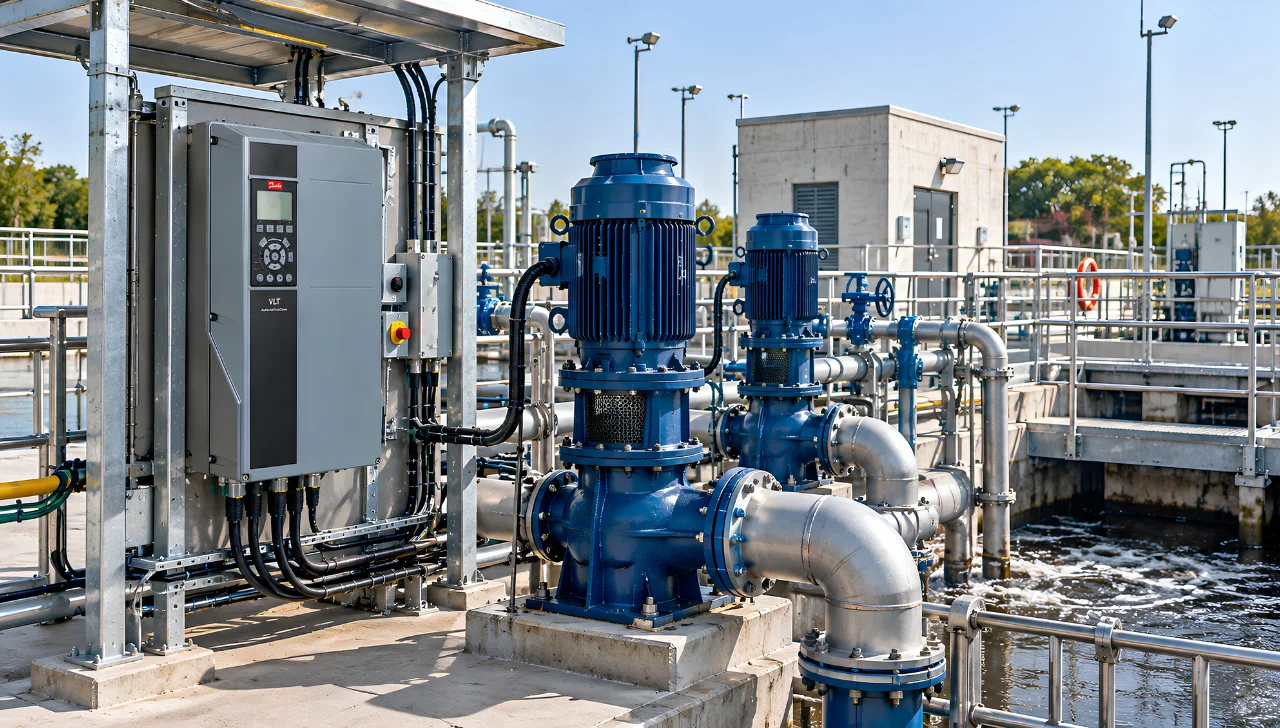
Wastewater pumping stations run around the clock, and that’s exactly why electricity bills at these sites get out of hand so quickly. A sewage lift station doesn’t get to shut down for the night or slow down over the weekend, it keeps moving whatever comes in, at whatever volume shows up. The problem is most plants still run pumps the same way they did decades ago, full speed, on or off, with a valve doing the fine-tuning. That approach wastes a lot of power, and it’s one of the easier things to fix once you understand how.
This article looks at why wastewater pumping is such an expensive load to run, how a VFD changes that, and what kind of savings a plant can realistically expect.
Why Wastewater Pumps Cost So Much to Run
A typical municipal or industrial sewage pumping station doesn’t see constant flow. Inflow rises during the morning and evening when households and factories are most active, and drops off overnight. But a fixed-speed pump doesn’t know that, it runs at one speed regardless of what’s actually coming in. When flow is low, the pump still pushes at full output, and a throttling valve or bypass line absorbs the excess. That’s effectively spending full electricity to move water you then partially block from moving.
This matters more in wastewater specifically than in most other pumping applications, and it’s part of how VFDs are changing water and wastewater management more broadly, because these stations run continuously, 24 hours a day, 365 days a year, often with very little downtime for maintenance. Even a small efficiency gain per hour adds up fast at that duty cycle. A pump that’s 20% more efficient across an 8,760-hour year is a very different number than the same 20% saved on equipment that only runs an eight-hour shift.
How a VFD Changes the Equation
A VFD sits between the incoming power supply and the pump motor, and instead of running the motor at one fixed speed, it adjusts the frequency of power going to the motor to match what’s actually needed. Less inflow at 3 AM, the pump slows down. Morning surge hits, it ramps back up. No valve throttling, no bypass losses, no constant full-speed running against partial demand.
The energy savings here aren’t small either. Pump loads follow what’s called an affinity law relationship between speed and power, meaning a pump running at 80% speed doesn’t use 80% of the power, it uses closer to half. Slow a pump down modestly and the power savings are disproportionately larger. For a lift station running continuously, this is often the single biggest energy-saving change a facility can make without touching the actual pump hardware.
For a lift station running continuously, this is often the single biggest energy-saving change a facility can make, a pattern that holds true across other VFD applications across industries, not just wastewater.
Beyond energy, there’s a mechanical side too. A pump switching between full stop and full start repeatedly wears down bearings, seals, and couplings faster than one that ramps smoothly. VFDs give a soft start and stop, which reduces the mechanical shock on the whole system, extending the life of pumps that are often expensive and slow to replace.
Matching Pump Speed to Actual Demand
The real value of a VFD in a wastewater application comes from pairing it with flow or level feedback. A level sensor in the wet well or a flow meter downstream tells the drive what’s actually happening, and the drive adjusts pump speed accordingly rather than running blind. This is usually handled through a PLC based pump controller, which automates the whole loop instead of requiring an operator to manually adjust speed throughout the day.
This kind of setup also helps avoid a problem that plagues fixed-speed lift stations: short cycling, where the pump starts and stops rapidly because the wet well fills and drains too fast for a single-speed pump to handle smoothly. A VFD can run the pump at a lower, steady speed that matches inflow more closely, keeping the well level stable instead of swinging between full and empty. That steadier operation is easier on the pump and easier on the electrical system pulling the current every time it starts.
Reducing Electricity Costs at 24/7 Pumping Stations
For a station running continuously, even a 15 to 25% reduction in average power draw translates into a meaningful annual saving, and that range is realistic for stations that were previously running fixed-speed with valve throttling. The savings come from three places working together: matching speed to actual flow instead of running at full output constantly, cutting out the energy wasted at the throttling valve, and reducing the peak demand charges that many electricity tariffs apply when a facility pulls large current spikes during full-speed starts.
That last point is worth calling out specifically for Indian utilities, where demand-based tariffs and time-of-day pricing are increasingly common. A VFD’s soft start avoids the current inrush of a direct-on-line start, which can meaningfully reduce the peak demand a facility gets billed against, separate from the energy savings themselves.
An energy audit is usually the right starting point if a plant hasn’t already switched to VFD-controlled pumping. It gives a clear picture of current consumption patterns, pump duty cycles, and where the biggest savings opportunity actually sits before committing to equipment.
Why the Danfoss VLT AQUA Drive Fits This Application
Not every VFD is built for wastewater duty specifically. Sewage and wastewater environments bring corrosive gases, humidity, and solids-heavy flow that can trip standard drives or shorten their service life if they’re not designed for it. The Danfoss VLT AQUA Drive FC-202 is built specifically for water and wastewater applications, with features tuned for pump protection, dry-run detection, and cable break monitoring that general-purpose drives don’t always include.
For a 24/7 lift station, that kind of application-specific protection matters more than it does in a lot of other industrial settings, and it’s worth a closer look at how the VLT AQUA Drive improves efficiency across broader water system applications, since downtime at a sewage pumping station isn’t just a production loss, it can mean a public health or environmental problem if wastewater backs up.
What a Retrofit Typically Looks Like

Most wastewater facilities aren’t starting from scratch, they’re retrofitting existing fixed-speed pumps rather than installing new ones. The good news is a VFD retrofit is usually a contained project, install the drive, wire in the level or flow feedback, commission the control logic, and the existing pump and piping stay exactly as they are. There’s no need to replace the pump itself in most cases, the motor just runs smarter.
The payback period on this kind of retrofit tends to be shorter than people expect, often well under two years for stations running continuously, once you account for both the direct energy savings and the reduced maintenance from smoother pump operation.
A Word on Sizing and Control Strategy
Getting this right depends on setting the VFD’s control parameters to match the actual pumping curve of the station, not just installing the drive and leaving it at default settings. A poorly tuned VFD can end up cycling the pump inefficiently or running it outside its best efficiency point, which eats into the savings you’re trying to capture in the first place. This is really the difference between a drive that’s technically installed and one that’s actually delivering the electricity savings it’s capable of, proper commissioning and control tuning matter as much as the hardware itself.
If you’re evaluating a wastewater pumping station for VFD retrofit or looking to reduce electricity costs on an existing setup, our team handles sizing, installation, and commissioning for water and wastewater applications, and we support ongoing AMC once the system is running. Get in touch for a site assessment.
Frequently Asked Questions
Most 24/7 stations moving from fixed-speed to VFD control see a 15 to 25% reduction in average power draw, depending on how variable the inflow was before and how the drive is tuned.
Yes, but the drive needs to be rated for the application. Wastewater environments involve moisture, corrosive gases, and solids-heavy flow, so a drive built for water and wastewater use, like the Danfoss VLT AQUA Drive, handles this better than a general-purpose industrial drive
It’s usually a contained cost since the existing pump and piping stay in place, only the drive and control feedback are added. Payback periods for continuously running stations are often under two years.
Yes. The soft start eliminates the current inrush of a direct-on-line start, which lowers the peak demand a facility is billed against on many Indian electricity tariffs.
For full benefit, yes. A VFD can run at fixed reduced speed without feedback, but pairing it with a level or flow sensor lets it automatically match pump speed to actual demand, which is where most of the energy savings come from.