



VFD in HVAC — AHU Full Form, Applications and Energy Savings Explained
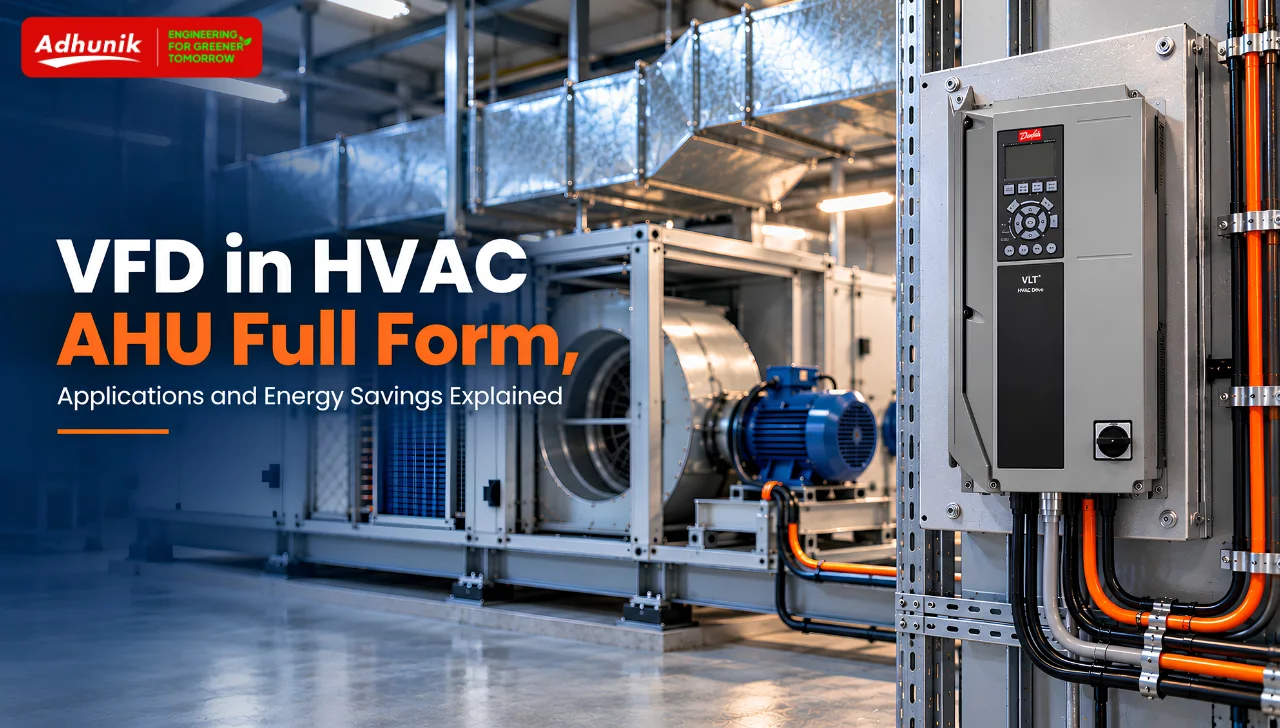
VFD in HVAC is one of the most important energy-saving technologies used in commercial buildings today. If you have seen this term on a maintenance report, electrical drawing, or energy audit, this guide brings the two sides together and breaks down what VFD in HVAC really means, what AHU full form stands for, and how these two things work together to cut energy costs in buildings across India.
HVAC full form: Heating, Ventilation, and Air Conditioning.
Before getting into VFDs, it helps to know the full form of HVAC itself. HVAC stands for Heating, Ventilation, and Air Conditioning. It covers every system that controls temperature, airflow, and air quality inside a building, from a small office AC unit to a large central plant in a hospital or mall. If you’re asked the full form of HVAC in an interview or exam, this is the answer: heating, ventilation, and air conditioning, working together as one connected system. In electrical drawings, the hvac full form in electrical labelling usually shows up as HVAC panel, HVAC load, or HVAC control wiring, since these systems run almost entirely on electrical power. Understanding this full form matters because every part of an HVAC system, from the smallest exhaust fan to the largest chiller compressor, ties back to one of these three functions.
What Does VFD Mean in HVAC?
Now to the main topic: what does VFD in HVAC actually mean? A VFD, or Variable Frequency Drive, is an electrical device that controls the speed of a motor by changing the frequency of the power fed into it. Motors are normally designed to run at one fixed speed based on the frequency of the incoming electrical supply. A VFD sits between the power source and the motor, and it can raise or lower that frequency on demand, which speeds the motor up or slows it down without any mechanical gearing.
In HVAC systems, VFDs are attached to motors that drive fans, pumps, and compressors, letting them run slower or faster based on how much heating or cooling a building needs at that moment. Instead of a motor running at full speed all day regardless of demand, a VFD in HVAC setup adjusts speed automatically, and that constant adjustment is where most of the energy savings come from. Our own breakdown of what makes a VFD an essential part of modern electrical systems goes deeper into the soft starting, harmonic reduction, and remote monitoring features that come with newer drives.
AHU Full Form and Where VFDs Fit In

To see how VFDs are actually used, you need to know the AHU full form. AHU stands for Air Handling Unit. It’s the large metal unit, usually installed on a rooftop or in a mechanical room, that circulates and conditions air before sending it through ductwork into offices, hospitals, hotels, and factories. The ahu full form in hvac drawings is written the same way: Air Handling Unit, feeding filtered, temperature-controlled air into a building.
An AHU has a large fan motor that pushes air through the ducts. This is exactly where a vfd for ahu setup becomes useful. A typical AHU has these main parts working together:
- Filters: remove dust and particles from incoming air.
- Cooling or heating coils: condition the air’s temperature.
- Fan and motor assembly: pushes air through the ductwork.
- VFD panel: controls how fast that fan motor runs.
Instead of the fan running at one fixed speed around the clock, a vfd ahu combination lets it slow down during low-demand hours, like early mornings or weekends, and speed up when more people are inside. A vfd air handling unit is now standard practice in new commercial construction, since it removes a large amount of wasted electricity that fixed-speed fans used to burn through, and it also reduces the strain on ductwork and dampers that used to do the job of controlling airflow mechanically.
How VFD for HVAC Systems Improves Energy Savings
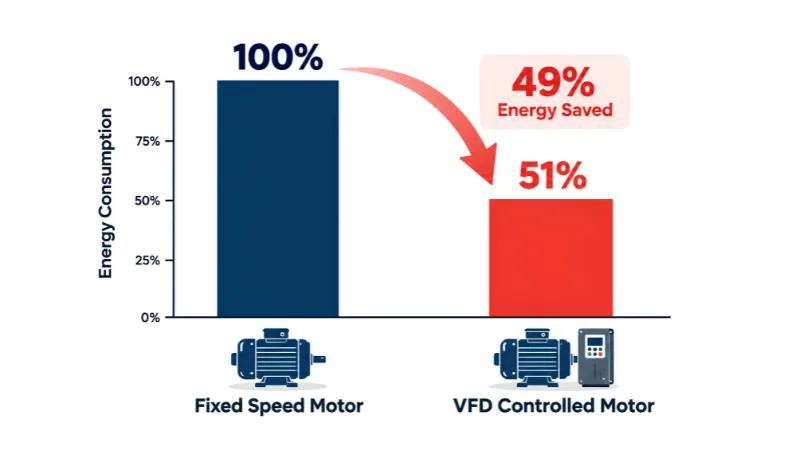
This is the part that matters most to building owners and facility managers. A vfd for hvac motor doesn’t just switch the motor on and off. It adjusts speed continuously, matching output to actual demand. Fan and pump motors follow what’s known as the cube law: cutting speed by around 20 percent can cut power use by nearly 50 percent, because the power a fan or pump draws rises much faster than its speed does. That means a properly tuned vfd hvac system can bring real, measurable savings on the monthly electricity bill, often paying for itself within one to two years depending on building size and running hours.
Buildings that install VFDs typically see savings in three areas: lower peak electrical demand, less wear on motors and bearings from constant full-speed running, and quieter operation since fans and pumps aren’t always pushed to maximum output. For hospitals, hotels, and factories running HVAC almost 24 hours a day, these savings add up fast, and the reduced mechanical stress also means fewer breakdowns and lower maintenance costs over the life of the equipment.
Signs Your HVAC System Could Use a VFD
Not every building needs a VFD on every motor, but a few patterns are a strong hint that one would help:
- The AHU fan or pump motor runs at full speed at all hours, regardless of occupancy.
- Dampers or control valves are constantly throttled to manage airflow while the motor never slows down.
- Motors overheat frequently or trip more often than expected.
- Electricity bills seem high relative to the building’s size.
- Fans or pumps are noticeably loud even during low-occupancy hours.
If two or more of these sound familiar, it’s usually worth getting the system checked for a VFD upgrade.
VFD Chiller and Other Applications Beyond AHUs
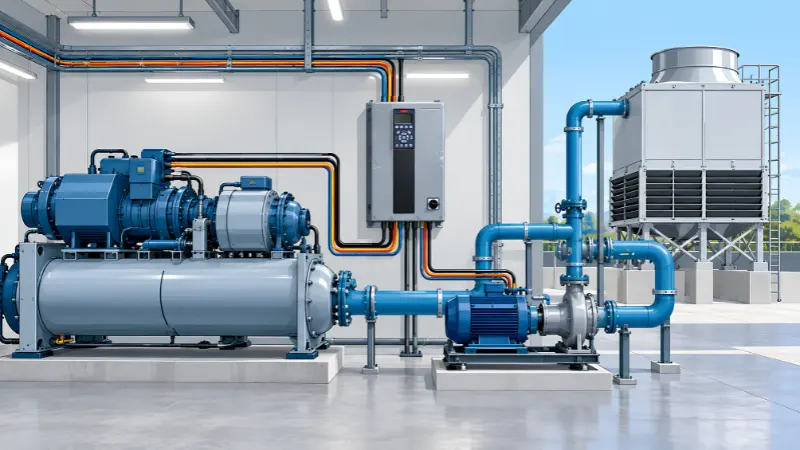
While AHU fans are the most common use, a vfd chiller setup matters just as much. Chillers use large compressor motors to produce chilled water for cooling coils, and running these compressors at variable speed instead of fixed speed cuts energy use significantly, especially where cooling demand shifts through the day. VFDs are also fitted on chilled water pumps, condenser water pumps, and cooling tower fans, so the whole cooling loop adjusts together rather than one part running flat out while another slows down.
On a smaller scale, a vfd for air conditioner works on the same idea. Split ACs and packaged units with inverter technology are really just using a built-in VFD to control compressor speed, which is why inverter ACs use noticeably less power than older fixed-speed models, and why they hold room temperature steadier instead of cycling on and off repeatedly.
How HVAC VFD Control Works in Practice
Setting up hvac vfd control usually involves a sensor, a controller, and the drive itself. A pressure or temperature sensor tracks conditions in the duct or the room, sends that reading to a building management system or a standalone controller, and the controller tells the VFD how fast the motor should run. This closed loop keeps the system constantly adjusting rather than running at one guessed speed all day.
A basic hvac vfd control setup usually needs:
- A sensor (pressure or temperature) to read current conditions
- A controller or building management system to process that reading
- The VFD itself, which adjusts motor speed based on the controller’s signal
- Correctly set minimum and maximum speed limits, so the motor never runs unsafely slow or fast
Getting this right takes proper commissioning. A poorly programmed VFD can run motors below their safe minimum speed, cause vibration issues, or fail to deliver enough airflow during peak hours. This is why VFD setup and tuning is usually handled by HVAC electrical specialists who understand both the mechanical side and the drive programming, rather than left to a general electrician as an afterthought. Adhunik’s work on panel design and motor control covers this exact overlap between electrical engineering and HVAC performance.
Frequently Asked Questions
A VFD in HVAC is a Variable Frequency Drive, an electrical device that adjusts motor speed by changing the frequency of the power going into it, so fans, pumps, and compressors run only as fast as they actually need to.
VFD stands for Variable Frequency Drive. In HVAC systems, it controls the speed of motors on AHU fans, chillers, and pumps to save energy and reduce mechanical wear.
The full form of HVAC is Heating, Ventilation, and Air Conditioning.
The AHU full form in HVAC is Air Handling Unit, the equipment that conditions and circulates air through a building’s ductwork.
If you are planning to install a VFD in HVAC systems across your facility or need guidance on drive selection and commissioning, Adhunik Automation provides VFD supply and installation across Delhi NCR, Noida, Ghaziabad, and Gurugram. Our team also handles energy audits to identify exactly which motors in your HVAC system would benefit most from variable speed control.
Call: +91 93100 85027
Email: kaushik@adhunikautomation.com